
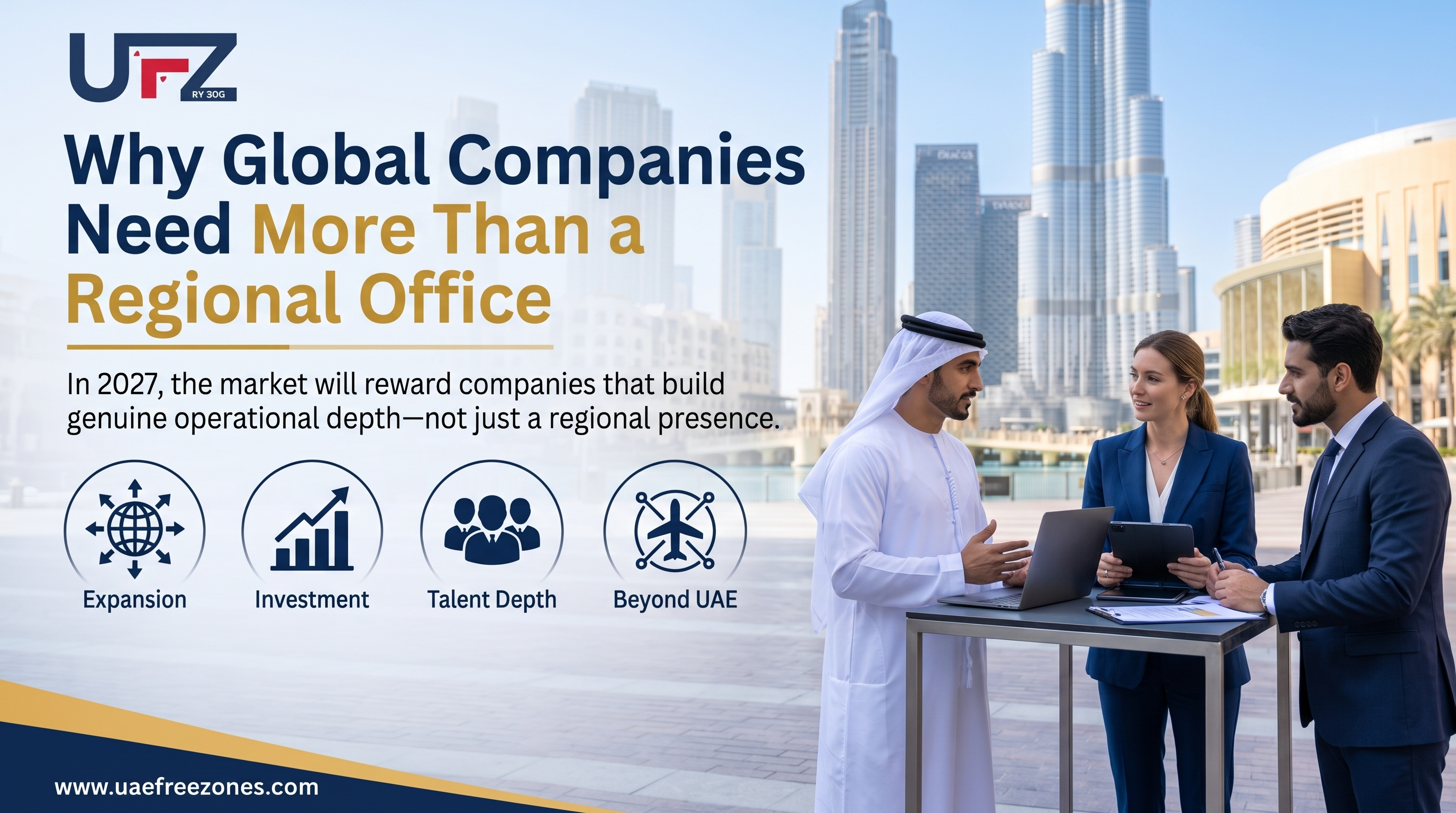
For years, many international businesses treated the UAE as a convenient sales hub: a small team, a distributor, and a Dubai address. That model is running out of road. In 2027, the market will reward companies that build genuine operational depth, not just a regional presence.
The numbers explain why. Foreign direct investment into the UAE reached USD 48.3 billion in 2025, up 6 per cent year on year, while non-oil foreign trade hit Dh1.937 trillion in the first half of 2026 alone. Add a flight radius of six to eight hours covering fast-growing markets across Asia and Africa, and the UAE becomes far more than a domestic sales territory. It becomes a platform for spreading engineering, training, and technical costs across dozens of countries.
Capturing that advantage, however, requires more than ambition. It requires the right operating model: one that combines local authority, long-term leadership, regulatory discipline, digital maturity, and direct accountability to the customer.
This guide explains what global businesses need to get right in the UAE in 2027, why a representative office is no longer enough, and how to build a regional hub that can compete for contracts, talent, and capital.
The UAE's appeal has never been limited to its domestic market. Its real value lies in what it connects: high-growth economies in Asia, Africa, and the Middle East, all within a short flight radius. Expanding Comprehensive Economic Partnership Agreements (CEPAs) are deepening those links by reducing trade barriers and opening new routes for goods, services, and investment.
For multinationals, this creates a multiplier effect that is difficult to replicate elsewhere. A regional hub can amortise technical, engineering, and training costs across dozens of territories. It can centralise procurement, compliance, and after-sales support. It can also serve as a testing ground for products that will later be adapted for Saudi Arabia, Qatar, Oman, Kenya, India, or Southeast Asia.
But that multiplier only works when the hub has real capabilities. A sales office that routes every decision back to headquarters cannot respond fast enough to local clients. A distributor that carries stock but lacks technical depth cannot protect specification integrity. A free-zone entity that exists mainly for tax purposes cannot build the relationships that win repeat business.
In 2027, the UAE market will separate companies that are merely present from companies that are genuinely operational.
A representative office can be a useful first step. It allows a foreign company to explore the market, build relationships, and conduct limited promotional activity. But it is not designed to manage complex projects, employ a full commercial team, or take direct responsibility for delivery.
As the market matures, the limitations become obvious:
The result is a gap between market opportunity and operating capability. Companies see the growth, but they cannot capture it at the speed or scale required.
Dubai's population rose 7.5 per cent to 4.58 million in 2025, driving demand across residential, hospitality, and commercial construction. The UAE also offers access to talent from more than 200 nationalities. But hiring international specialists is not the same as giving regional leaders real authority.
Products designed for Europe, Asia, or North America rarely work unchanged in the Gulf. High humidity, different household habits, and aggressive project schedules demand fast technical and commercial decisions. A façade system that performs well in a temperate climate may fail under intense heat and salinity. A kitchen specification that suits European apartments may not fit the way larger Gulf households actually live. A delivery schedule built around a six-month lead time may collapse when a developer compresses the programme.
When a regional director has to wait weeks for approval from a distant head office, deadlines slip and contracts are lost. The cost of delay is not just administrative. It is measured in idle crews, missed handover dates, penalty clauses, and damaged relationships.
The answer is not to abandon global standards. It is to set clear brand and governance rules at headquarters, then let local leaders make decisions in the client's time zone. Define what cannot change: brand positioning, ethical standards, safety requirements, core product architecture, and financial controls. Then delegate everything else: pricing within approved bands, specification adjustments, local sourcing, service escalation, and customer credits.
This is the difference between control and centralisation. Control protects the business. Centralisation slows it down.
Short-term expatriate rotations of two or three years can undermine institutional memory, especially when major real estate and infrastructure projects take three to five years from specification to handover. A regional director who arrives, learns the market, and leaves before the project completes cannot provide the continuity that clients value.
Companies need long-tenure regional leaders, structured handovers, and a serious approach to Emiratisation. That means integrating UAE nationals into commercial, regulatory, and key-account roles, not treating mainland hiring targets as a payroll exercise.
Emiratisation works best when it is built into the operating model rather than added at the end. UAE nationals can bring regulatory knowledge, government relationships, cultural fluency, and long-term market perspective. They can also serve as the bridge between international headquarters and local partners.
Continuity builds relationships, and relationships build trust in a market where reputation travels quickly. A client who has worked with the same regional team for five years is more likely to award the next phase, recommend the company to a developer, or give early warning of a specification change.
UAE corporate tax now requires proactive planning rather than year-end fixes. Taxable income above AED 375,000 is subject to a 9 per cent rate, while free-zone benefits depend on maintaining Qualifying Free Zone Person substance and properly ring-fencing qualifying income.
For multinationals with both a free-zone regional hub and a mainland contracting or retail business, intercompany pricing and contract routing must withstand scrutiny. This is not just a finance issue. It affects how contracts are structured, where profits are recognised, how services are charged, and how risk is allocated.
The bigger operational deadline is electronic invoicing. Under the Ministry of Finance's phased rollout, businesses with annual revenue of AED 50 million or more must implement structured e-invoicing from 1 January 2027, with smaller enterprises following on 1 July 2027.
Once invoices move digitally in real time, any mismatch between quotations, unpriced design changes, customer tax records, and delivery documents will stall billing almost immediately. A missing purchase order reference or an unapproved variation can block payment at the exact moment cash flow matters most.
Companies should audit their order-to-cash processes well before January. That means mapping every step from quotation to collection, identifying where data is rekeyed, and fixing the gaps between sales, operations, and finance. The businesses that treat e-invoicing as a compliance project will struggle. The businesses that treat it as commercial architecture will gain faster billing, cleaner data, and stronger customer trust.
Gartner forecasts IT spending across the Middle East and North Africa to reach USD 169 billion in 2026, an increase of 8.9 per cent. Yet bigger technology budgets do not automatically produce better unit economics, especially when companies bolt customer-facing AI tools onto fragmented legacy systems.
In complex fit-out projects spanning hundreds of homes, margins leak quietly during handoffs between estimation, factory production, and site installation. A tender may be priced on assumptions that production cannot meet. A custom unit may be manufactured before the site is ready. A delivery may be dispatched before payment security is confirmed.
Fast-growing markets also tempt companies to chase order books on loose payment terms or ship before sites are ready. Revenue looks strong on paper, but cash conversion weakens and rework rises.
The strongest operators apply digital workflows and AI directly to these pressure points:
A single digital backbone that keeps commercial, engineering, and field teams working from live data will outperform isolated automation pilots. Every technology investment in 2027 should be measured against clear outcomes: fewer estimation errors, fewer site revisits, and faster cash conversion.
In 2027, contracts are increasingly won before pricing is even discussed. Under the UAE's Net Zero 2050 pathway and municipal green-building codes such as Dubai's Al Sa'fat and Abu Dhabi's Estidama, verified low-emission materials, supply-chain traceability, and climate-resilient engineering have become tender requirements rather than marketing extras.
Developers and government clients increasingly ask for environmental product declarations, recycled content data, energy performance evidence, and proof of responsible sourcing. A glossy sustainability brochure is not enough. The documentation must be verifiable, project-specific, and available at pre-qualification stage.
Execution matters just as much after contract award. The UAE's consumer protection framework places clear statutory obligations on suppliers for warranties, spare parts, and after-sales support. Brand reputation is built at handover and during year-three warranty service, not in the showroom.
International companies should therefore ask whether their local operating model can meet that standard:
These questions matter because sustainability and quality are now commercial differentiators. A supplier that cannot answer them will be excluded before price is considered.
Third-party distributors remain useful for early market entry. They offer immediate access to customers, local knowledge, and established logistics. But high-volume core markets increasingly favour a direct presence, or a tightly governed hybrid model, that keeps control over specification, installation quality, and lifecycle margin.
| Operating model | Best for | Main advantage | Main risk |
|---|---|---|---|
| Representative office | Market exploration and relationship building | Low cost and low commitment | Limited authority and execution capability |
| Distributor | Early entry and niche products | Fast access to local customers | Weak control over specification and service |
| Direct subsidiary | High-volume core markets | Full control over delivery and margin | Higher fixed cost and compliance burden |
| Hybrid model | Complex projects and mixed portfolios | Balances local reach with direct accountability | Requires strong governance and clear roles |
The right choice depends on the product, the customer segment, and the level of technical support required. For commoditised products, a distributor may be sufficient. For engineered systems, complex fit-outs, or government contracts, direct accountability is often essential.
A resilient regional business rests on six pillars:
Companies that build all six will be able to compete for larger contracts, attract stronger talent, and protect margins as the market grows. Companies that focus on only one or two will find themselves exposed when competition intensifies.
A strong UAE operating model can be measured through a small set of indicators:
These metrics connect operational depth to financial outcomes. They also give headquarters a clear view of whether the regional hub is creating value beyond its own market.
A representative office is limited in what it can do commercially and operationally. It struggles to manage complex projects, employ a full local team, take direct responsibility for delivery, and respond quickly to customer needs. In 2027, larger contracts and sophisticated buyers require a presence with real decision-making authority and accountability.
UAE corporate tax applies at 9 per cent on taxable income above AED 375,000. Free-zone incentives depend on maintaining Qualifying Free Zone Person substance and ring-fencing qualifying income. Businesses should review their structure, intercompany pricing, and contract routing before the next financial year.
Under the Ministry of Finance's phased rollout, businesses with annual revenue of AED 50 million or more must implement structured e-invoicing from 1 January 2027. Smaller enterprises follow on 1 July 2027. Companies should audit their order-to-cash processes well before the deadline.
A distributor provides fast market access but limited control over specification, pricing, and service. A direct subsidiary gives the company full control over delivery, customer relationships, and margin, but carries higher fixed costs and compliance obligations. A hybrid model can balance local reach with direct accountability.
Major real estate and infrastructure projects often take three to five years from specification to handover. Short expatriate rotations can erode institutional memory and weaken client relationships. Long-tenure regional leaders and structured handovers help preserve trust and market knowledge.
Meaningful Emiratisation goes beyond meeting payroll quotas. It involves integrating UAE nationals into commercial, regulatory, and key-account roles where they can build careers, contribute market knowledge, and strengthen relationships with government and local partners.
Companies should fix their digital core before scaling AI. That means connecting commercial, engineering, and field data in one system, then applying automation to specific pain points such as tender takeoffs, engineering validation, site readiness, and payment security. AI should be measured against outcomes, not novelty.
The UAE's Net Zero 2050 pathway and municipal green-building codes such as Dubai's Al Sa'fat and Abu Dhabi's Estidama increasingly require verified low-emission materials, supply-chain traceability, and climate-resilient engineering. Developers may also request environmental product declarations and energy performance evidence.
A strong regional hub combines empowered local leadership, long-term continuity, tax and regulatory discipline, a unified digital backbone, verified sustainability credentials, and direct accountability for installation and after-sales service.
Use metrics such as local decision speed, invoice rejection rates, days sales outstanding, estimation accuracy, warranty response time, regional revenue contribution, and senior leadership retention. These indicators show whether the hub is creating value beyond its own domestic sales.
The UAE is no longer simply a sales outpost. Entering 2027, the market favours companies that build a genuine centre of operational competence: empowered regional leadership, long-term continuity, disciplined tax and e-invoicing compliance, a practical digital backbone, and direct accountability to the customer.
At UAE Free Zones, we assist entrepreneurs and international companies with Business setup services, including licence selection, company registration, documentation, visa processing and corporate banking assistance. Explore our Company formation services in UAE or learn more about a UAE Free Zone Company to find the structure that fits your regional plans.